Educational pet-health and visit-preparation reference. Not a diagnosis, prescription, dosage recommendation or substitute for a veterinarian. Veterinary review: pending. This is an editorial educational reference. Checking sources is not a veterinary assessment of your pet.
Choose three meaningful daily activities
You do not need to score every behavior. Choose three familiar activities, such as coming for food, reaching a resting place and seeking company. Note whether each is usual, needs help or is no longer possible, with a concrete description. This is a Petwell communication aid, not a validated quality-of-life scale or a treatment or euthanasia decision tool.
Section sources: AAHA: Communicating with families of senior pets
Look for changes in each species’ routine
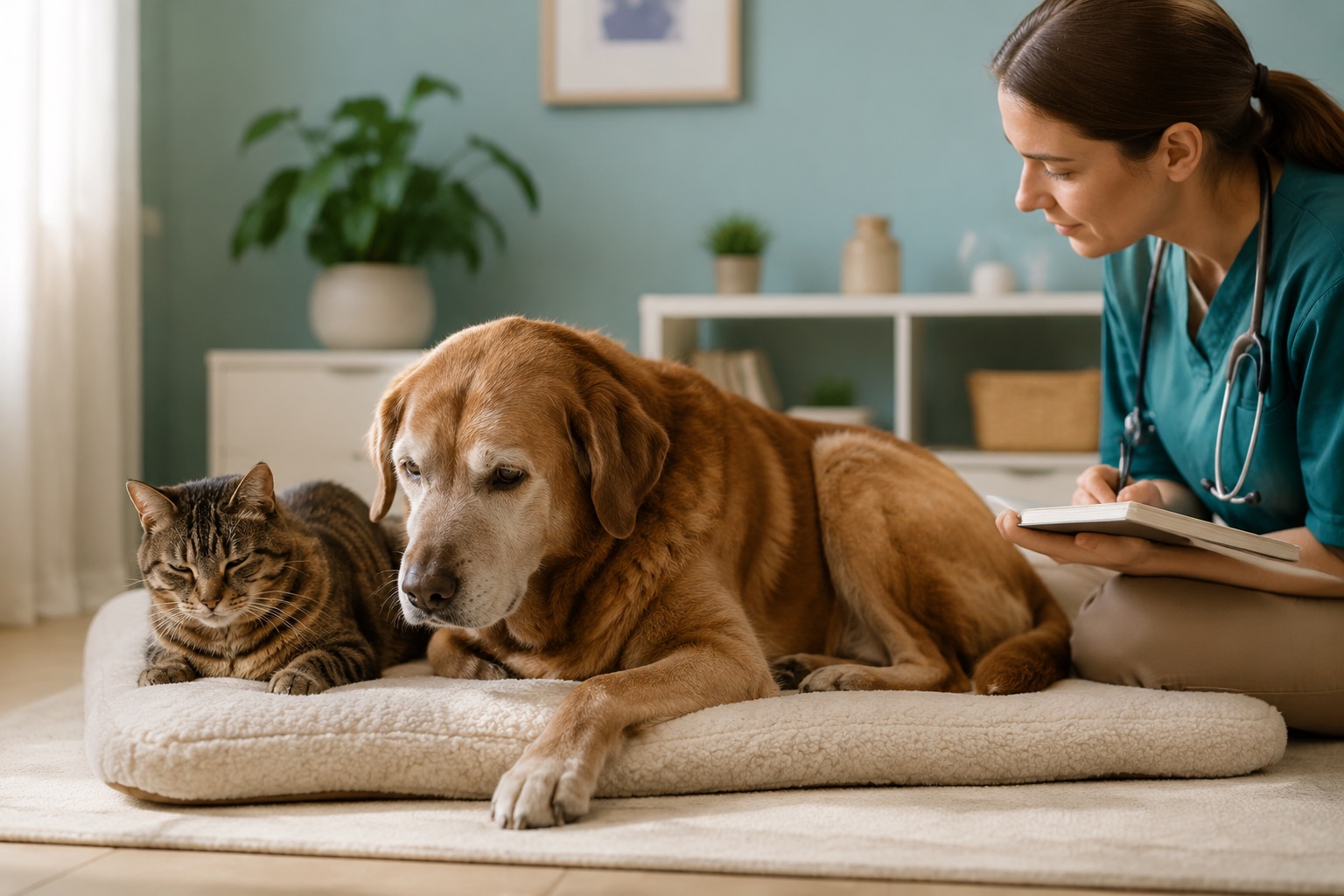
For cats, note changes in access to favorite perches, grooming or entering the litter box. For dogs, note slower rising, shorter familiar walks or hesitation on slippery floors. Observe natural activity; do not demand jumps or long walks as a test. New nighttime restlessness, thirst or weight change needs assessment rather than an assumption of aging or cognitive decline.
Section sources: AAHA senior care: Pain and home environment
Make one daily route easier
Check the route from bed to water and toilet: does it require jumping, stairs, slippery flooring or a high edge? Consider secure mats, accessible bedding and a low-entry litter box while keeping the route familiar. Check whether each change helps. Discuss supports, ramps and exercise with the veterinarian, especially with existing pain or neurological problems.
Section sources: AAHA senior care: Pain and home environment
Bring trends and practical difficulties to a review
Bring a few representative dated notes, how weight was measured, appetite changes, a medicine list and short clips of natural activity. If family views differ, record each person’s observations instead of only debating whether a day was good. Agree on the most useful measures, the next review and reasons to call sooner. Explain difficulties with medication, lifting or overnight care.
Section sources: AAHA: Communicating with families of senior pets
Do not wait for the next diary entry
Breathing difficulty, collapse, seizures, inability to urinate, severe pain or sudden inability to walk require immediate veterinary contact. You do not need a full week of notes to report worsening. Do not give human pain medicines or alter long-term treatment yourself; the diary supports a consultation.
Section sources: Merck Veterinary Manual: When to see a veterinarian · AVMA: Pet first aid brochure
Use this guide to prepare for a visit
Senior care note Three usual activities: Today’s changes/help needed: Appetite, water, toileting, sleep: Weight and measurement date: Medicine/environment changes: Hardest part of care:
Record observations for this topic Visit checklistSources & editorial context
- AAHA: Communicating with families of senior pets ↗American Animal Hospital Association · Editorial check: 2026-10-12 · Source date: 2022-12-13
Individual care goals, follow-up questions, home comfort and feasible care. - AAHA senior care: Pain and home environment ↗American Animal Hospital Association · Editorial check: 2026-10-12 · Source date: 2022-12-13
Behavior change, home video, mobility support and environmental changes; part of the 2023 guidelines. - Merck Veterinary Manual: When to see a veterinarian ↗Merck Veterinary Manual · Editorial check: 2026-10-12 · Source date: Not clearly stated on source
Urgent signs including breathing difficulty, collapse, severe pain, bleeding, seizures and difficulty urinating. - AVMA: Pet first aid brochure ↗American Veterinary Medical Association · Editorial check: 2026-10-12 · Source date: Not clearly stated on source
Poison exposure information, no unadvised vomiting induction or medication, hospital contact and transport.
What changed
Added individual baselines, species-specific observations, accessible routes and care-goal discussions; the diary is not a clinical score.
Dates identify editorial updates and source checks, not clinical approval. All four languages were edited together; native-language and veterinary review remain pending.
Read our editorial policy